
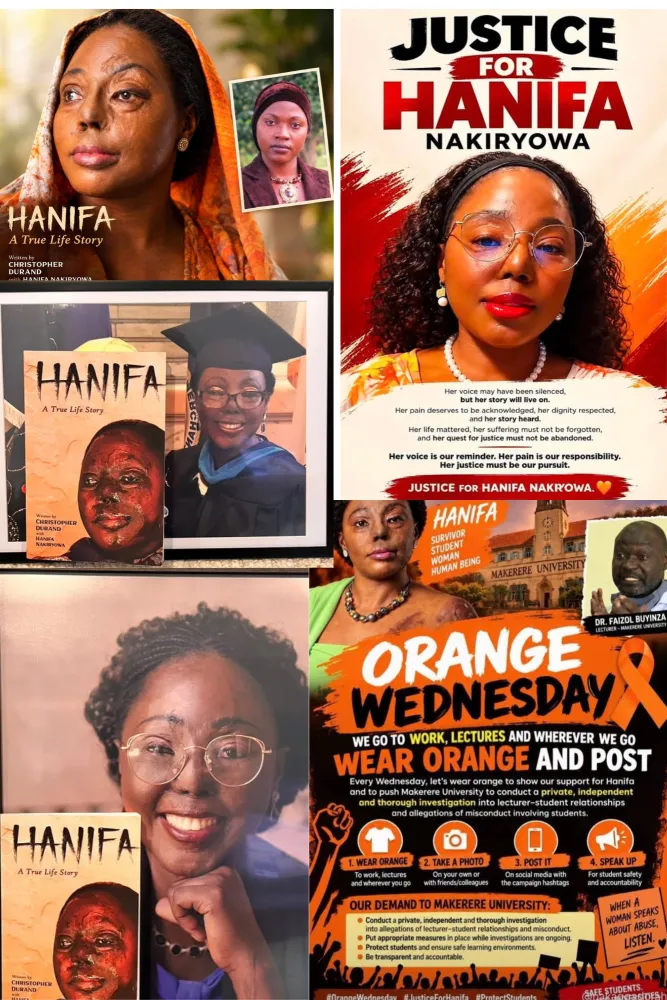
Justice for Hanifa: No Student Should Have to Trade Dignity for Education
Education should be a safe space for learning, growth and opportunity, not a place where students experience sexual harassment, coercion or abuse of power.
For Hanifa Nakiryowa, founder of the Centre for Rehabilitation of Survivors of Acid and Burns Violence (CERESAV), her experience as a student at Makerere University became the beginning of a painful journey that continues to shape her advocacy for justice and survivor rights.
Hanifa has spoken about experiencing sexual harassment and abuse of power while she was a student. She has stated that a lecturer in a position of authority over her withheld her academic results as a means of pressuring her into a sexual relationship. What followed was years of violence and trauma. In December 2011, after leaving a violent marriage, Hanifa survived a concentrated sulfuric acid attack that left her with life-changing physical and emotional injuries.
Today, Hanifa has transformed her experience into advocacy, founding CERESAV to support survivors of acid and burns violence and work towards preventing violence against women and girls.
A Wider Problem
Hanifa’s story is not simply an individual experience. Sexual harassment and abuse of power remain serious concerns in higher education.
According to findings from the Kicking Sexual Harassment out of Higher Education Institutions (KISH) survey reported by Daily Monitor, more than 80% of the 317 female students interviewed at Makerere University had experienced at least one form of sexual harassment, while 91% of those who experienced harassment never reported it. Fear of retaliation and lack of trust in reporting mechanisms were among the reasons for this silence.
Makerere University has also previously investigated allegations of sex-for-marks and sexual exploitation. A 2018 investigation reported that lecturers had used their positions of authority to pressure female students for sex and, in some cases, threatened academic consequences when students refused.
These findings raise an important question: Are our institutions doing enough to protect students from abuse of power?
#JusticeForHanifa
The #JusticeForHanifa campaign calls for stronger accountability and safer learning environments for all students. Our Change.org petition, “Condemn Harassment and Abuse of Power in Uganda’s Higher Educational Institutions,” has already received more than 6,000 signatures.
We are calling on relevant authorities and educational institutions to strengthen mechanisms for reporting and investigating sexual harassment, protect students and whistleblowers from retaliation, and ensure that academic power is never used to coerce students into sexual relationships.
Hanifa’s story reminds us that behind every statistic is a person whose education, dignity, safety and future can be affected.
No student should have to exchange sex for marks. No survivor should be silenced. And no story should be left untold.
Join CERESAV in amplifying #JusticeForHanifa and #NoStoryLeftUntold. Sign the petition HERE, share the campaign, read Hanifa’s story HERE, and stand with survivors.
Together, we can demand institutions where students are respected, protected and able to pursue their education without fear of harassment, retaliation or exploitation. Justice requires accountability, meaningful protection, and action that places student safety first every day.